Showing posts with label Portugal. Show all posts

23 Jul 2012

Impressions of Portugal

Firstly I’d like to point out that I only spent two weeks in Portugal and only nine days of which was spent visiting wineries. Secondly I only visited four (five if you treat Oporto separately) regions in Portugal, all of which are in the northern part of the country. I was also able to visit some of the absolute top producers in each of these regions and thus was only able to experience the best of what Portugal produces. This does also mean that I was exposed to the cutting edge and future of Portuguese wines, and meet people with experience in different regions and producers representing different elements of the wine industry. So it seems a little silly to be making assumptions and assessments about a country that requires significantly longer to get to know, but I wanted to talk about Portugal which is a producer that certainly I had very little experience with and understanding of, but feel that everyone out there needs to get to know better.

Traditional method sparkling wine in Bairrada

21 Jul 2012

It's not easy being green (Vinho Verde, Portugal)

The Vinho Verde region is in the far northern part of Portugal on the border with Galicia, Spain. The astute amongst you would have noticed (if you didn't already know) that the translation into English is literally 'green wine'. I'm sure most people would hear this name as I did when I was out for dinner in Lisboa, and be slightly shocked at the idea of green wine. The name of course refers to them being young wines that need to be drunk within 12 months, and the fact that the grapes are harvested a little early to retain the acidity. There are around about 30,000 growers in the region who predominantly grow the fruit in pergolas so that they can grow other crops underneath and more intelligently use the land. The wines are pretty awful in general, and are mass-produced and often pumped with carbon dioxide to give it a little spritz. As far as I know this is the only region where the region is named after the wine rather than the other way around. The associations with the region and the quality of the wine don't make it way for the few producers who are trying to make higher quality wine, the most prominent of which I visited in the evening.

Duck rice, a typical dish from Minho in northern Portugal

Extremes (Duoro, Portugal - Day Three)

Considering there are about 44,000 hectares of vineyards planted you can imagine the size of the region and the range of terroirs, so there are a myriad of opportunities for different expressions. There are so many elements of the Duoro that are taken for granted in many other regions well known for super-premium wines, such as very old vines, steep slopes and thousands of  different vineyard owners. Something that they haven't had in the past was wine that was designated as a single estate or vineyard, something that is so common in places like Burgundy, Mosel and Alba. The Duoro Boys are at the forefront of raising the Duoro Valley to the same level as such iconic regions, highlighting the aspects generally regarded as of the highest quality. They are also attempting to differentiate the Duoro through the very traditional elements like the great range of varieties planted often in a field blend, and the fermentation and maceration of red wines in lagares mostly made of stone. Having the abilities and technology to much better understand their terroirs, varieties and wines there is very little to stop Duoro wines in the future.


Amazing vineyards at Quinta do vale Dona Maria

Alright, still (Duoro Valley, Portugal – Day Two)

The shift of focus from fortified port wines to still wines could not have waited much longer in the Duoro. The entire fortified wine market has been diminishing since the 1980s as more people have been drinking dry wines all over the world. The limitations of matching port with food don’t help with the accessibility of these wines as well, as there are only so many styles and they are generally sweeter and all more alcoholic. In the past fortified wines were one of the most popular categories – particularly port and sherry wines – and they were even produced as far away as the USA and Australia. The growth of still wine production of course has been seen all over the world to the unfortunate detriment of fortified wines. Thus in an effort to stay alive it was important for the producers of the Duoro to explore the opportunities of still wine production, and in a sense it couldn’t have come at a better time. The climate is one of the biggest influences on the style of wine they can produce which is big, rich and red. This style of wine has been popular for about 20 years in a number of key markets around the world, thanks in part to the influence of US wine critic Robert Parker who loves this style of wine. Thus a confluence of factors has provided them a great opportunity into the future. The producers I visited on my second day are some of the most important producers of still wine in the region.

If it weren't empty I would be making wine angels

19 Jul 2012

Déjà vu (Douro Valley, Portugal – Day One)

After six months visiting wine regions in Europe I feel like I am beginning to come full circle. Every major wine-producing country has been covered, and with the exception of Bordeaux (next week) and Burgundy (the end of the year), every important wine region has been visited. The experience and knowledge I have acquired since the beginning of the year scares me slightly, and I hate the idea that I am becoming jaded with my knowledge of wine. I think the time I have planned in the UK and Ireland through August will do me some good, as it will refresh me for working vintage in Germany from mid-September. Probably the main reason that I am feeling a sense of déjà vu is the similarities that the Duoro Valley has with the Mosel Valley, which I visited all the way back at the end of January. The way the calm and wide river makes its slow progress to the Atlantic Ocean is hauntingly similar to the Mosel, as well as the deep valley with steep slopes planted with terraced vineyards. They even have some slate/schist here, but a lot more granite and even limestone. There is obviously one glaring difference which is the climate. It is very hot here, often reaching well over 40 degrees in summer, whereas the Mosel is not. When I was in the Mosel it wasn’t getting over zero degrees; on my first day in the Duoro it got up to 39 degrees. So a little bit different. I came here to not only actually see the vineyards where the port wine comes from, but to also explore a rapidly growing part of the Duoro for dry table wines, getting quite a following.

High above the vineyards of the Duoro

17 Jul 2012

Porto to the past (Porto, Portugal – Day Two)

In case you weren’t aware (and I certainly wasn’t), the Duoro Valley where port wine is produced was the first officially demarcated viticultural areas in the world in 1756, although Chianti and Tokaji were regionally defined but not regulated before this. The actual viticulture and initial fermentation is no different to any other red wine, but the fruit can tend to be a little riper with more natural sugar in it. After the fortification the wine used to travel down the river on boats in barrels, but today the wine travels on the road in climate controlled tanks. When you visit Vila Nova de Gaia on the left bank of the Duoro in Porto, you can still see the barcos rabelos moored and floating, and now they are only used for racing and tourism. British merchants were permitted to import port at a low duty in 1703 which led to the wine gaining much popularity, partly because the war with France deprived English wine drinkers of French wine. The English involvement in the port trade grew much like in sherry, and still remains today in the names of many port shippers such as Cockburn, Croft, Gould, Osborne, Offley, Sandeman, Taylor, Graham, Dow and Warre, the last three of which are owned by the same family and I had the chance to taste on my second day in Porto.

Port boats docked in Villa Nova de Gaia

15 Jul 2012

Hard a' port (Porto, Portugal - Day One)
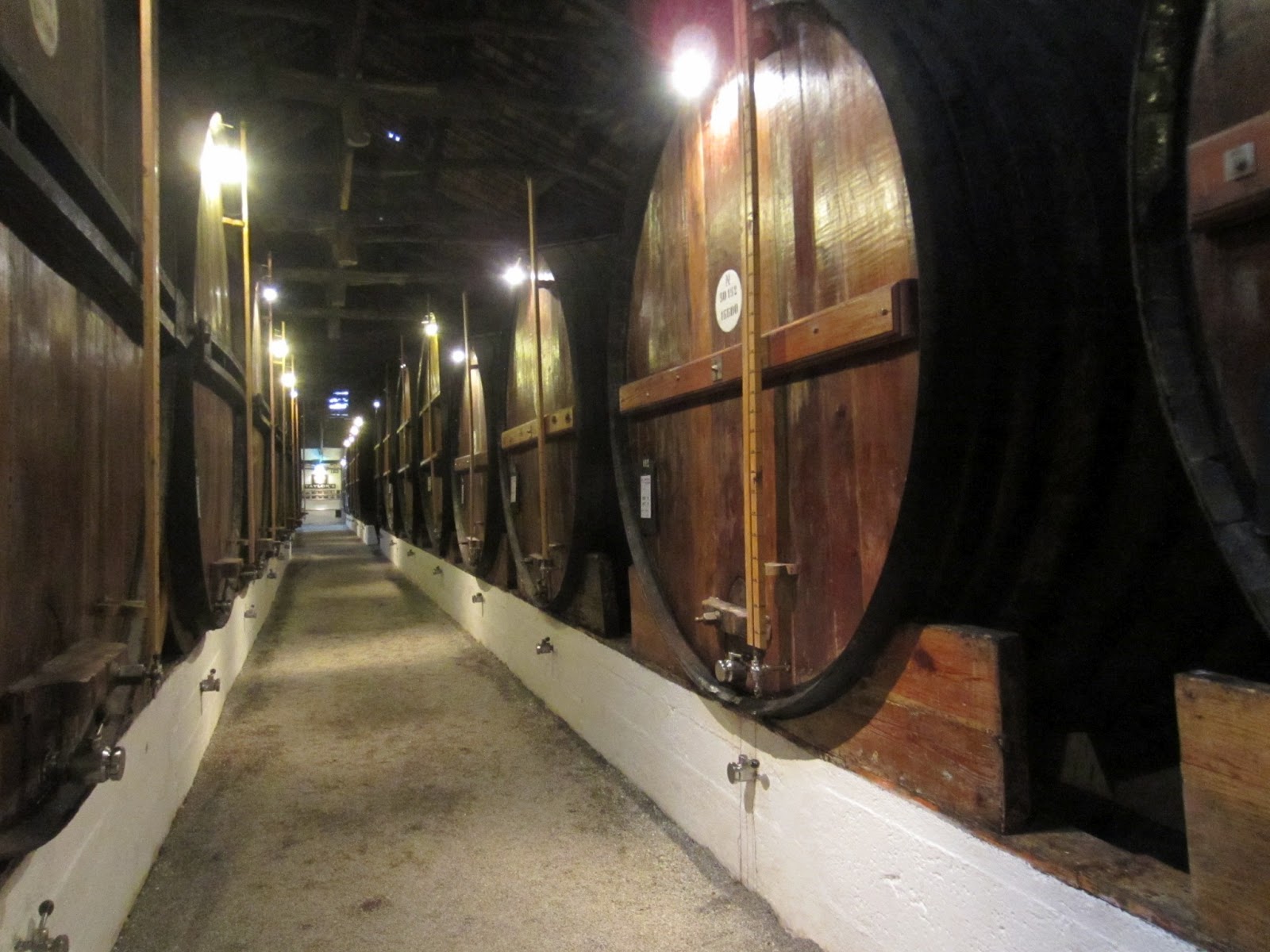
Only a week a go I was talking about a style of wine considered to be very old fashioned and makes one think of old British movies. This wine was sherry, and it is interesting that about two weeks later I am here where they produce the other wine that comes to mind which is port. Sherry and port share a few things in common apart from being thought of as an old persons drink. Firstly they are both fortified wines, but in the case of port the fortification is made during the fermentation to stop it and retain a residual sugar, whereas sherry with the exception of pedro ximinez and muscatel are fortified after the fermentation. Secondly the fortification was important for the transportation and spread of port as it was for sherry, but it was actually British wine merchants who introduced the process into port whereas the Moors introduced it in sherry. The third similarity is with the fact that like dry sherries, cask-aged port doesn’t age in the bottle and should be consumed pretty soon after bottling, whereas vintage port ages in the bottle and can keep for a very long time indeed. The first fundamental difference between the two is that the vast majority of port is made from red grapes, whereas more sherry is made from white grapes. Along the same lines, almost all port is sweet whereas the majority of sherry is either dry or medium-dry. Like sherry however, port is also undervalued and underappreciated, and the best examples are truly exceptional wines regardless of their style.

The port halls of Taylor's

14 Jul 2012

The future starts here (Dao, Portugal - Day Two)

Knowing so little about Portuguese wine everything I am experiencing is new to me. With such an objective opinion of wine and the wine industry here, I am open to different ideas and I have been developing some ideas which may or may not be particularly accurate. One of the first things I noticed about wine in Portugal compared to other European countries is that more premium wines tend to be a little more expensive, particularly in restaurants where they have pretty much the same mark-up as in Australia. The second thing I have noticed is that there is a big difference between commercially produced wines and more premium boutique wines both in terms of quality and volume, but there seems to be a huge gap in the middle with very few medium-sized wineries. The third thing I have noticed is a lack of cooperation between wineries, which I experienced when visiting one winery and them talking in a slightly negative or condescending way about other wineries. Obviously these wines are competing with each other, but perhaps they need to look a little bigger and consider that they are actually competing with other product categories like beer, spirits and countless non-alcoholic beverages. You also can’t ignore the trend for the best Portuguese wines to be consumed within Portugal, with port the only exception. All of these reasons combine to create a situation where very few outside the country know how good the wines are, and as such not much is exported in a profitable way. Hopefully this will change as new groups have been established to promote the wines around the world. The two wineries I visited on my second day in the Dao region are probably the most important for the region in the export markets.

Sandy granitic soils in Dao

Terroir hunter (Dao, Portugal - Day One)

The Dao and Bairrada geographical regions are part of the same political region in Portugal known as Beiras. I don’t recommend mentioning that with them, as the two regions couldn’t be more different from each other in a great many ways. Firstly the Dao region is more continental in climate than the Bairrada which is closer to the Atlantic Coast, and thus has more temperature variations between day and night time. Secondly the Dao region is higher in altitude sitting at over 250m above sea level, whereas the Bairrada isn’t much more than 100m. Thirdly the region works with very different grape varieties; the Dao is much more known for red wines whereas Bairrada produces sparkling wine in high volumes, with red and white wines occupying a smaller piece of the pie. The wine styles are quite different, with the maritime wines of Bairrada being more linear, fresh and crisp and the wines of Dao being fuller and more robust. The final difference is in the landscape itself, as the Dao is much more wild and rugged, reminding me of the Grampians in Victoria where I come from. The Dao is a valley formed over time like a big bowl, and in this protected climate the touriga nacional grape is the undisputed king.

The Intrepid Wino in a medieval lagare in the Dao, Portugal

13 Jul 2012

Baga me (Bairrada, Portugal – Day Two)

There are a small number of grape varieties can be set apart from all others. Their defining characteristic is that they can only be grown in a few specific parts of the world, and can only be made well in the best places by people who truly respect the partnership between the vine and the environment. Another of their defining characteristics is that they are the few that should always be made as mono-varietal still wines, and are also hugely influenced by the viticulturalists and winemakers who work with them. For white wines there is really only two in my humble opinion - riesling and chardonnay – although the latter is one of the most planted white varieties in the world. In terms of red wine there is a select group with a few knocking on the door. The outsiders are syrah, sangiovese and tempranillo, whilst the insiders are pinot noir and nebbiolo. There is one Portuguese variety that has been spoken about as joining this elite few, and that variety is baga. I agree that the variety has the potential to have the same silky tannins, delicate yet firm structure, and brightness of fruit that characterises the other two, but I need to taste more before I am certain it isn’t an also-run. I also believe the winemakers here need to get more experience, as they have only been making premium wines from this variety quite recently.

Above the vineyards of Campolargo in Bairrada, Portugal

Living on the edge (Bairrada, Portugal – Day One)

I could have picked a lot worse places to celebrate entering my fourth decade on the planet than Lisbon, a city that lives up to its status as a European capital city. Much alcohol and little sleep was enjoyed over the weekend, and many visits to the Bairro Alto part of the old town as well. Whilst it was nice having five days off from the wine as I celebrated my 30th birthday, it was almost relief to get back into the familiar territory of visiting wine regions. The only problem with that idea is the fact that I know almost nothing about Portuguese wine, even the most famous one of all, port. I’m always up for a challenge, and relished the chance to learn about a country not really appreciated outside their borders, mostly because they aren’t great at promoting their regionally distinct premium wines, and partly because most of the good stuff is consumed within the country. I chose to visit only three regions which represent the top quality wines and are all in the northern part of the country within Oporto, the second largest city. The first was the coastal region of Bairrada, which has been known for its sparkling wines for many years but is starting to gain recognition for its red wines made from the indigenous baga variety.

Traditional method sparkling wines at Sidonio de Sousa