 |
| Very cool labels in Walla Walla, Washington |
Showing posts with label Oregon. Show all posts
Showing posts with label Oregon. Show all posts
2 Nov 2011
Pacific Northwest - what I've learnt
Wineries don't need to be on the vineyards they source fruit from. They don't even need to be in the same region. Wineries in the Willamette Valley (Oregon) source fruit from Walla Walla (Washington). Wineries West of the Cascade Mountains in Washington source fruit almost exclusively from the East of the state. Red Mountain, a quarter of the size of the Walla Walla AVA, actually produces more fruit, but very little of the wine is made there. If a winemaker wants to make a particular style of wine, they will find the fruit they need. Many wineries deal with the tyranny of distance in different ways. Numerous wineries in the Western part of Washington were established close to Seattle, such as in Woodenville. The town of Walla Walla has been set-up as a wine tourism oasis. The Willamette on the other hand is naturally blessed with being less than an hour from Portland, but the Southern Oregon regions are not so lucky. The fruit for the wine may travel far, but visitors to wineries shouldn't have to, and wine tourism hubs are as common as shopping districts in town.


26 Oct 2011
Dramatic landscapes (Columbia Gorge, Oregon/Washington)
I'm starting to get used to the disappointment that I can't spend more time in all the places I am going, and Portland was one of the hardest to leave so far. It's much nicer staying in the hostels because you are around people more and there's stuff to do in the evening. It's nice having some space and quiet in the motels, but it's pretty boring and lonely. It does give me a chance to catch up on things and look ahead for arrangements, but I do waste a bit too much time flipping through the thousands of channels on the television.
The Columbia River is one of the biggest I have ever seen, and stretches at least 80 metres wide most of the time. As you drive east out of Portland you are treated to very lush vegetation and trees, which are particularly beautiful at this time of year as the leaves change colour. The Columbia River becomes the Columbia Gorge as hills shelter the river on both sides. To the South is the state of Oregon, and to the North is Washington which is my next destination. Like a number of regions in the Pacific Northwest, Columbia Gorge sits across the two states. The only winery that was open was Cathedral Ridge, and the wines were pretty ordinary so not worth talking about. The only interesting wine was a secret blend of riesling and an undisclosed red wine.
An interesting thing happens as you drive East along the Columbia River. Once you hit the town of Lyle on the Washington side of the river, the scenery changes from lush verdant forests and green grass, to very dry and sparse semi-arid tundra. The difference is both stark and sudden. As you drive on the ridges of the Columbia Gorge you see extensive wind farms as far as the eye can see. Victoria could learn a lot from this area, as they are certainly not an eyesore, looking like toothpicks sticking out of a leg of lamb from afar at sunset.
One of the largest wineries in Washington, and the 100th to get their license, was Maryhill Winery. Maryhill can be found on a very scenic ridge that has amazing views both up and down the river. The most exciting thing about this winery is that they truly understand the value of wine tourism. Columbia Valley is at least two hours from the closest major city, and isn't between any major cities either. There are very few wineries in this area, and the ones that are aren't amazing. There are very small communities that are spread out and there aren't a lot of things to do. So they have created a reason for people to come out; concerts. An amphitheatre was built from day one 10 years ago, and they have just opened a brand new multi-purpose stage. They have hosted the likes of Lyle Lovett, Styx and Counting Crows, and most weekends have music playing in the courtyard. The wines are very good but not amazing, and many have some R/S, but that is what their customers want.
https://picasaweb.google.com/103966152761599927074/ColumbiaGorgeOregonColumbiaValleyWashington?authuser=0&feat=directlink
 |
| Colubia Valley, Oregon to the left, Washington to the right |
 |
| Cathedral Ridge Halbtrocken |
 |
| Windfarms in Washington |
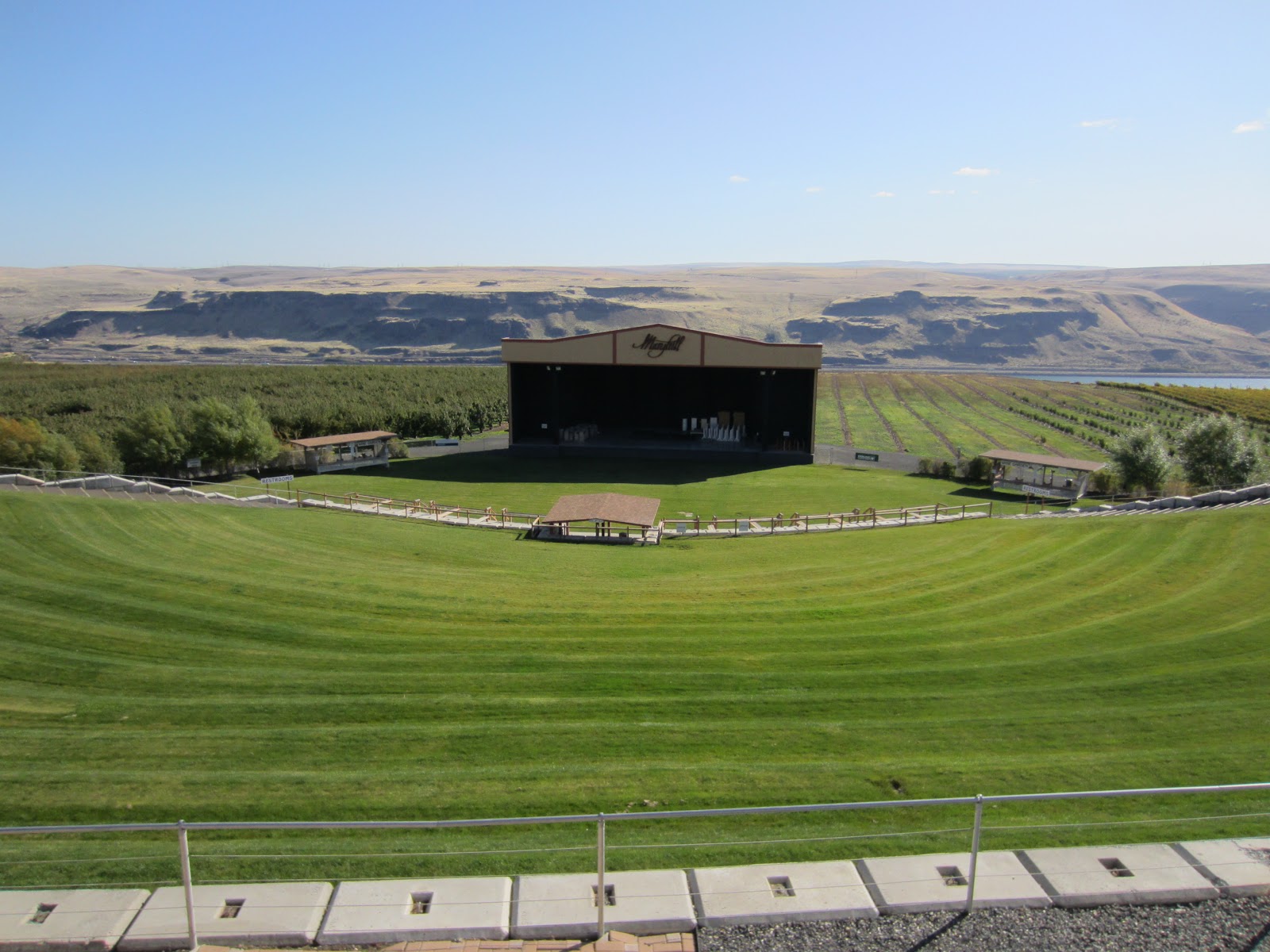 |
| The Maryhill amphitheatre and stage |
23 Oct 2011
Variations on a theme (Willamette Valley, Oregon - Day 3)
One of the major things I'm going to take away from my time in the Willamette Valley is that there are so many variables in wine that can influence style. Even though pinot noir is the king of grapes in Oregon, there is such a wide variety of styles due to site, clone, vintage and winemaking. In one day today I saw such a range of wines that it was hard to believe they all came from the same grape variety.
At short notice I had managed to get an appointment to taste the wines at Beaux Freres, and boy was I glad I did. The name Robert Parker Jnr. is probably the most important in the USA, and no one influences trends in wine more than he has. So when Michael Etzel found a site in the Ribbon Ridge sub-sub-region in 1986 on which to grow grapes, he partnered with his brother-in-law Robert Parker to find a third backer to purchase and establish the property. It wasn't difficult to do this, and in 1991 after working several vintages at Willamette pioneer Ponzi Vineyards, he decided not to sell his fruit but make the wines himself. The rest was history.
The focus at Beaux Freres is clearly on pinot noir, as they only produce wine from this grape. Today they only release three wines, a blend of the two vineyards they grow on, and the two single vineyard wines. The tasting consisted of comparing two vintages of two of the wines, and finish with the other single vineyard wine which needs more time before being offered full-time. When wines are made in such a hands-off style and the fruit is allowed to express the naunces of the site, you can see a big difference between vintages. The 2007 wines looked exquisite, with tight acid and tannin holding the fruit together well. These wines will live. The 2009 wines are very young but will soften and then hold together for less time. The Beaux Freres wines were the best I tried in the Willamette Valley.
In 1991 the wine world stood up and took notice of the Willamette Valley and Oregon for pinot noir. The catalyst for this was the inaugural release of the Domaine Drouhin 1988 Pinot Noir. The fact that one of the most important houses in Burgundy had invested in a new world winery, and identified the quality and potential of wines from this region was big news. A flurry of new operations and investment swept over the valley, inflating the number of producers and the overall quality of the wines. The Drouhin winery is one of the most important in the Willamette Valley, as it was the first entirely gravity-fed in the region. They are one of the larger producers, but there is no compromise on the quality. It is exciting to see some great chardonnay here, it's a shame there isn't more, but from the sounds of it they are planting more suitable clones for the climate. As I walked through the winery pinot fruit was being processed and you can see the stems falling down a chute into a bin below.
This past week in New York City was the Wine Spectator 2011 Wine Experience, a three-day festival where the best wines in the world are on show. A number of the wineries I have visited were exhibiting their wines, including Kistler, Ridge and Shafer. I had contacted Michelle from Domaine Serene about visiting the winery, but unfortunately she would be over for the event as well and wouldn't be at the winery to meet me. I thought I'd drop in and taste some wines anyway, and it was interesting to see the difference in expression between two wineries so close to each other. The Domaine Serene pinot noirs are full, dense, dark and tannic, and a little warm. They are wines that require ageing, compared to the wines at Domaine Drouhin which are soft and approachable in youth. The syrah uses fruit sourced from the Oregon side of the Walla Walla region, and is nice and earthy and dark with good concentration and spice.
I was really pleased to have met the winemaker at Stoller Vineyards, Melissa Burr. The vintage had begun and they were naturally very busy in the winery processing fruit, so I was glad she could spare some time. At age 31 she is one of the youngest chief winemakers I have met, so it was really exciting to taste her wines and hear her background. She seemed very interested in my background and future plans, so I hope I can stay in contact with her as I think she will be a very important winemaker wherever she goes. I highly recommend reading her winemakers blog, as it is great insight into the goings on at Stoller. http://blog.stollervineyards.com/
Argyle is one of the oldest wineries in the Willamette Valley, and their focus is on sparkling wines. The cool climate is ideal for growing fruit for sparkling base, and it was nice to see them using pinot meunier in the classic Champagne mould. The most fascinating wine was probably the sparkling pinot noir wine, which was nothing like the classic Australian sparkling shiraz, but delicious nonetheless. Argyle only make vintage bubbles, which is rare in both the old and new world.
Before heading back to Portland I stopped in at the Chehalem Tasting Room in Newberg. Chehalem is part owned by the Stollers, and is located in the Chealem Mountains AVA. The wines themselves are very sound, delicious and full. There is good balance and depth to them, however I feel that they are on the safe side and aren't taking any risks. The risk and revolutionary element at Chehalem is the fact that they seal all their wines under screwcap, conducting many years of closure trials. In a region that is predominantly pinot noir red wine, this is a bold stance and should be commended. The founder of the winery, Harry Peterson-Nedry, happened to be in the tasting room, and it was fascinating talking to him, as such an important figure in the region and a pioneer. He generously invited me to contact him should I want to come back to Oregon to work vintage in the future, which I am considering now...
Portland is a very relaxed city, and the business district is very easy to get around. I spent the following just wandering around as is my wont. Most of the famous food carts were closed for the weekend, but I really enjoyed the soul food style BBQ pulled pork sandwich from one that was open. The botanic gardens are lovely, and nicely located on a hill above the rest of the city. I wish I were spending more time here, as it is my kind of town. On to Washington tomorrow, onwards and upwards!
https://picasaweb.google.com/103966152761599927074/WillametteValleyOregonDay3?authuser=0&feat=directlink
 |
| Pinot noir fruit at Domaine Drouhin Oregon |
The focus at Beaux Freres is clearly on pinot noir, as they only produce wine from this grape. Today they only release three wines, a blend of the two vineyards they grow on, and the two single vineyard wines. The tasting consisted of comparing two vintages of two of the wines, and finish with the other single vineyard wine which needs more time before being offered full-time. When wines are made in such a hands-off style and the fruit is allowed to express the naunces of the site, you can see a big difference between vintages. The 2007 wines looked exquisite, with tight acid and tannin holding the fruit together well. These wines will live. The 2009 wines are very young but will soften and then hold together for less time. The Beaux Freres wines were the best I tried in the Willamette Valley.
 |
| Beaux Freres Vineyard Pinot Noir 2007 & 2009 |
 |
| Pinot stems after de-stemming |
 |
| Domaine Serene SoNo Syrah |
Argyle is one of the oldest wineries in the Willamette Valley, and their focus is on sparkling wines. The cool climate is ideal for growing fruit for sparkling base, and it was nice to see them using pinot meunier in the classic Champagne mould. The most fascinating wine was probably the sparkling pinot noir wine, which was nothing like the classic Australian sparkling shiraz, but delicious nonetheless. Argyle only make vintage bubbles, which is rare in both the old and new world.
 |
| Argyle Black Brut Sparkling Pinot Noir |
 |
| The Chehalem Tasting Room |
https://picasaweb.google.com/103966152761599927074/WillametteValleyOregonDay3?authuser=0&feat=directlink
22 Oct 2011
Sub-regional revolution (Willamette Valley, Oregon - Day 2)
It's safe to say that wine regions in the USA, much like in Australia, are big. This makes it difficult to categorise a region as having a certain style or characteristic. This is partly because there are differences in approaches to winemaking, but mostly becasue there are countless micro-climates and differences in appelation and site within a broad region. The size of the region also means you are covering a large distance when you are visiting, and getting from one appointment to another in time can have complications.

Having tasted the Bergstrom Pinot Noir with Mark Bixler from Kistler, and also noticing its reference in Vertical (new Rex Pickett book), I was intrigued to visit the winery. It's a relatively new player but has been gaining serious attention from consumers and media alike. This doesn't surprise me as the wine style is definitely in the more robust and full spectrum. Lot's of black forest fruit and dark cherry with dense tannin structure. These are wines that in a group of pinots in a blind tasting or wine show would stand out. They are expressive of their location in the Chehalem Mountains AVA, which is characteristically elevated marine sediment soils. The gentleman tasting next to me was clearly a devoted follower, as he was buying at least six dozen bottles.
The team at Elk Cove had invited me to join them for vintage lunch, so I was in a bit of a hurry to get there on time as I didn't want to miss out. Elk Cove was the first winery to be established in the Yamhill-Carlton sub-region, way back in 1974. Since establishing they have grown to be one of the most important producers in Northern Oregon, owning vineyards covering 220 acres. Like the vast majority of the Willamette Valley, Elk Cove is proudly family owned and operated, the winemaker Adam is the son of Pat and Joe Campbell that established the estate. Pat makes a mean lunch, a delicious feast of mexican-style faire pork ribs and tortillas, which all the trimmings. Enjoying the good food and discussion we were late in starting the tasting of some fantastic wines, and I ended up being a bit late for the next appointment. I was sad to leave Elk Cove in such a hurry, but I'm sure our paths will cross again.
Similar to Elk Cove, Adelsheim Vineyards was the first winery established in the Chehalem Mountain AVA in 1971, by David and Ginny Adelsheim. Again much like Elk Cove, they have grown significantly in stature and size, now totalling 190 acres of vineyards. The winemaking facility is pretty large, when I visited they had a lot of vats of pinot noir fermenting and macerating. Many other wineries haven't started vintage but Adelsheim are almost half way through. They make a number of wines, including an Auxerrois which is very sharp on the palate, i.e. high acidity. The pinot noir wines are very generous and soft, and some of the labels feature beautiful drawings as you can see below.
Getting late I could only fit one more winery in, and it had to be close. A former assistant winemaker at Rex Hill Winery, Lynn Penner-Ash established her own winery with her husband Ron Penner-Ash in 1998. She had previously worked at Stag's Leap Wine Cellars, the famous winner of the 1976 Paris Tasting. The winery and estate is located on a hill in the Chehalem Mountain district, and has an amazing view, as you can see below. The wines are pretty full-on, dark and earthy. Not heavy per se, but products of the 2009 vintage being quite warm. I was very apprehensive about the pinot syrah blend, but was shocked to discover it was a great wine, and great value at $20. One of the tasting room hosts was interested to hear of my recent studies, as she is considering studying wine marketing at Adelaide University.
Check out some of the other photos I took on this day by clicking the link below.
https://picasaweb.google.com/103966152761599927074/WillametteValleyOregonDay2?authuser=0&feat=directlink

Having tasted the Bergstrom Pinot Noir with Mark Bixler from Kistler, and also noticing its reference in Vertical (new Rex Pickett book), I was intrigued to visit the winery. It's a relatively new player but has been gaining serious attention from consumers and media alike. This doesn't surprise me as the wine style is definitely in the more robust and full spectrum. Lot's of black forest fruit and dark cherry with dense tannin structure. These are wines that in a group of pinots in a blind tasting or wine show would stand out. They are expressive of their location in the Chehalem Mountains AVA, which is characteristically elevated marine sediment soils. The gentleman tasting next to me was clearly a devoted follower, as he was buying at least six dozen bottles.
 |
| Bergstrom Winery Block Pinot Noir 2009 |
 |
| Elk Cove La Boheme Pinot Noir Vineyard |
 |
| Adelsheim Elizabeth and Caitlin's Reserve wines |
 |
| The view from Penner-Ash winery |
https://picasaweb.google.com/103966152761599927074/WillametteValleyOregonDay2?authuser=0&feat=directlink
21 Oct 2011
Come on down to pinot town (Willamette Valley, Oregon - Day 1)
I think that Alexander Payne and Jim Taylor richly deserved the Academy Award for best adapted screenplay for Sideways. Having finished Rex Picketts sequel to the novel Sideways, and seeing how poor not only his prose is, but also his proof-reading, I can only imagine how badly written his first book must have been. It's been interesting to discover what happens to the characters, and it might make an interesting film sequel. It has also proved interesting to read it as I have travelled up the west coast, following almost the same route as Miles and Jack. I have now arrived at the zenith of the novel, and the primary wine region the characters reside in. That region is the Central Otago equivalent of North America; the Willamette Valley.
 Steve Naughton from Pinot NOW had given me a detailed list of wineries to visit, and over the past few weeks I had contacted most of them, and most had got back to me. Much like the rest of my trip up the coast so far, my timing was a little off as vintage was fast approaching and the much smaller wineries in the Willamette Valley were tentative to set anything up until closer to the date. They were very positive about me visiting, which was a lot more than I had gotten out of some Californian regions.
As I headed up the driveway of Evesham Wood there were small trays of freshly picked pinot gris and pinot noir sitting at the ends of rows. These were off some of the lower blocks of the estate vineyard, and up at the winery they were understandably anxious about what this record-breaking delayed harvest would provide. This is only the second vintage that the winemaker Erin Nuccio has been entirely in charge, and as was 2010 this vintage is set to be challenging. It's a very small winery built next to and under the owners house, which is now vacated since they are enjoying early retirement. Newly pressed pinot gris juice were seeping out of the bladder press, as small batches fermented in the cellar in small kegs. Several small fermenters held crushed and de-stemmed pinot noir fruit cold-soaking on skins to draw some colour before fermentation. It was far from crazy, but on the precipice. Erin was really cool and nice to spare a bit of time to chat about my trip so far and my plans. Sensing his mind was elsewhere I excused myself and hit the road.
There was a similar feeling of trepidation around the corner at Cristom. The winemaker at Cristom is Steve Doerner, and he has a serious pinot noir background at Calera. He lamented the delayed commencement of vintage in the fact that cellar hands that had secured leave from various positions were soon to return to work, leaving him short staffed once more fruit started to come in. In the background John Farnham was playing, courtesy of the cellar hand joining them from Henshke. Steve has a very hands-off approach to his winemaking, less new oak, less maceration on skins, more whole-bunch fermentation. It is not hard to see the influence in the wines, which are very subtle, and express the site better than a lot of the wines I tried in California. It may have something to do with less intervention in the winery?..
On the same hill as Cristom sits Bethel Heights, established in 1977 by twin brothers Ted and Terry Casteel. The tasting room sits above the vineyards and has a beautiful vista, accompanied by the winery cat bathing itself. It was interesting to try the three single block pinot noirs they produce, as two of them are a Dijon clone introduced less that 20 years a go. The third block was planted to Pommard clone back in 1977 before the Dijon clone had been introduced. Comparing the three wines, the Dijon clone wines looked very tight and young, whereas the Pommard clone wine was more developed, fuller and silkier, more approachable now. They also made the best un-oaked chardonnay I have tried so far.
Several people including Steve Naughton had suggested I visit Eyrie Vineyards, but I had neglected to do my research as to why. The winery and tasting room are in the town of McMinnville, and it reminded me of visiting Alsace where the wineries tend to be in the towns rather than on the estates. I soon learnt the reason why the winery was located here, as Eyrie was the first vineyard planted in the Willamette to pinot noir and chardonnay, and the first to pinot gris in the USA. The vineyards are on Dundee Hill, and in the late '60s it would have been complicated to get machinery and trucks, not to mention visitors up there.
The wines made here are fascinating. They use barely any new oak, and tend to use it only on their lower priced pinot rather than the reserve. Clearly they understand that the oldest vines produce fruit that needs the least done to it in the winery. They had one pinot which was a non-vintage blend of 2006, 2007 and 2008 fruit, and was intended to raise funds for the cellarmaster's wife's kidney transplant, which as you can imagine is expensive in the States. The Reserve Estate Pinot Noir was a unique and exceptional wine, but the stand-out was the very Alsation-inspired pinot gris.
I was very excited to visit the Carlton Wine Studio for two reasons. The first is that it is a co-operative winery where very small artisan producers make and exhibit their wines. The second reason is that I lived for the last three years in the Melbourne suburb of Carlton. Tasting through the pinots it was fun to see the different expressions, from different sub-regions, to different winemaking styles. One wine in particular was a deep purple colour, intense and dark but not heavy. The style of wine was reflected in the bottle; deep punt, thick heavy glass and a metallic label.
The little I have seen so far of Portland has been excited about, and I look forward to experiencing it more over the next few days.

As I headed up the driveway of Evesham Wood there were small trays of freshly picked pinot gris and pinot noir sitting at the ends of rows. These were off some of the lower blocks of the estate vineyard, and up at the winery they were understandably anxious about what this record-breaking delayed harvest would provide. This is only the second vintage that the winemaker Erin Nuccio has been entirely in charge, and as was 2010 this vintage is set to be challenging. It's a very small winery built next to and under the owners house, which is now vacated since they are enjoying early retirement. Newly pressed pinot gris juice were seeping out of the bladder press, as small batches fermented in the cellar in small kegs. Several small fermenters held crushed and de-stemmed pinot noir fruit cold-soaking on skins to draw some colour before fermentation. It was far from crazy, but on the precipice. Erin was really cool and nice to spare a bit of time to chat about my trip so far and my plans. Sensing his mind was elsewhere I excused myself and hit the road.
 |
| Freshly picked pinot noir at Evesham Wood |
 |
| Evesham Wood Winery |
 |
| Cellar Hands at Cristom glad to have some fruit to process |
 |
| The Bethel Heights Winery cat |
 |
| The Eyrie Vineyards Tasting Room |
 |
| The Eyrie Reserve Pinot Noir |
 |
| The Retour Pinot Noir at the Carlton Wine Studio |
Click here to see more photos from Day One in the Willamette Valley, Oregon.
19 Oct 2011
Oh, the scenery! (Rogue Valley & Eugene, Oregon)
What a change, to drive from Ukiah in Northen California into Southern Oregon. Once you get past Redding, California the scenery becomes a lot more dramatic. You start to see a lot denser pine forests and heading up into more mountainous climbs. The highway becomes steeper and more curvy, and before long you see the snow covered Mount Shasta approaching. And not long after that, you are in Oregon, without any fanfare at all. It's a pretty long drive from Ukiah to Eugene, so I broke it up by stopping in Medford at the heart of the Rogue Valley.
I called into the second largest winery in the region, named Roxy Ann Winery. Historically the estate was covered in orchards, but was converted to wine grapes just over ten years ago. They are best known for their pinot gris of which they make quite a bit, but I thought the standout in terms of value was the Honour Barn Red. I got the chance to try their pear wine, which was very dangerously easy to drink. The other winery I dropped in on was Del Rio, the largest in the region. Unfortunately owing to the fact I didn't have a business card "proving" that I worked in the wine industry (something I have since remedied thanks to Staples' four hour turnaround) I could only try one wine. Both wineries had a Claret, a term that apparently can be used as long as it was before the watershed imposed by the EU.
 |
| RoxyAnn tasting room |
The hostel I am staying in here in Eugene is very cool, as is the town itself. It's a University town, and also a very arty laidback vibe. A local cafe was recommended to me for good organic vegetarian fare, which I was jonesing for after a week of nothing but protein, carbohydrates and sugar. A few meals of just vegetables and beans can really do you good, giving you a natural high. It was nice to just chill out and read a book for a change, getting out of the car for a while. I also had to make some appointments in the Willamette Valley.
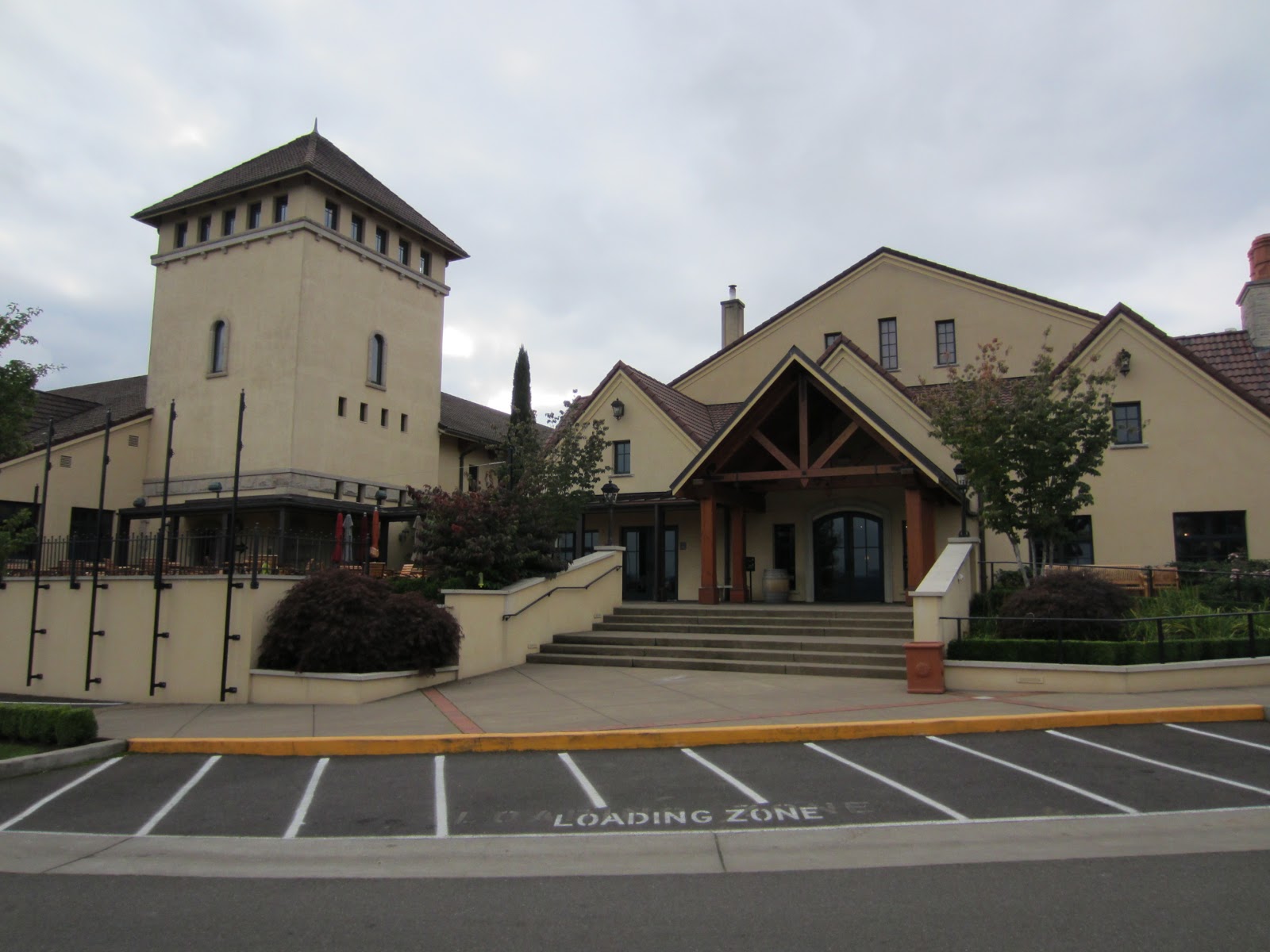 |
| King Estate |
Whilst I was in Eugene I headed out to King Estate which is probably one of the largest producers in Oregon, which isn't anything compared to some of the wineries I visited whilst I was in California. Similar to Roxy Ann, King Estate are best known for their pinot gris, and I managed to get some good photos of the 2011 fruit on the vine. The pinot noirs they produce are pretty serious, and sit within several price ranges, rewarding consumers as they spend more. It's a gorgeous estate that sits atop a hill looking across vines and majestic pine covered hills. Not a bad place to work, assuming the weather is good which it wasn't on that day.
 |
| Pinot gris fruit getting some hang-time |
Click here to see more photos from the Rogue Valley.
Subscribe to:
Posts (Atom)