Showing posts with label United States of America. Show all posts

9 Mar 2012

Prowein 2012, aka "The Business" - Dusseldorf, Germany

I'm not ashamed to admit that I am a Wine Trade Fair virgin. Way down in Australia we don't have anything like this as it is not a big enough market for such a trade fair, and most of the market is dominated by six wine companies. The closest thing we have is individual distributors inviting their producers to show new release wines either once a year or every other year. Having visited Prowein 2012 I can say that this is preferable, as there are far less producers to see and I am familiar with them all. There is also the fact that I know many other attendees and can chat about the wines with them. Attending Prowein is a little bit like the edible room scene in Willy Wonka and the Chocolate Factory, except in that scene they knew what everything was and what they wanted to taste. I spent most of my time wandering around not knowing many of the producers and not knowing which were good enough to visit. It is amazing to see all of these big bright shiny stands, and the layout is generally clear and makes sense. There are a lot of stands for negociants and importers, so you sometimes stumble on Australian wines in the German hall, or French wines in the Spanish hall.

Shiny Prowein 2012
The second problem that I had was the difficulty in tasting the wines completely out of context. I have now been travelling for five months across three wine continents, where I visit the regions vineyards and wineries before tasting a selection of wines. Tasting wines with owners and winemakers at the estate gives you wonderful perspective and understanding and deepens the connection with the wine. Tasting at Prowein is inelegant and unromantic for a number of reasons. The first is that in such a crowded and corporate environment there is no connection to what makes the wines so unique and great, which is the vineyards and winery. The second is that producers are often distracted, exhausted, overwhelmed and so bored with saying the same things over and over again. They have little interest in talking to someone who isn't a customer in the immediate future. The third reason is that the vast majority of wines on offer are brand spanking new, mostly still in barrel/tank or freshly bottled wines that are far too young to truly appreciate and enjoy. The German wine trade/consumers like their wines young before they are even ready and actually expressing something.

VDP pavilion at Prowein 2012
I spent the Sunday of Prowein 2012 in Hall Four which was dedicated to Germany, and most of this was spent in the VDP section where I caught up with producers I had visited or ones that I hadn't but wanted to. It was great to meet with and try some new wines with people like Kuenstler, Wittman, Christmann, Leitz, Hans Wirsching, Gunderloch and Buerklin-Wolf. I was also glad to be able to meet and try wines with such amazing German producers as Fritz Haag (Mosel), Emrich Schoenleber & Dr. Crusius (Nahe), Rebholz & Becker (Pfalz) and Kuehn (Rheingau). All of these producers were astonishingly good, with Haag, Crusius and Kuehn particular highlights.

Spanish pavilion at Prowein 2012
The second day at Prowwin was spent in Hall Seven which was dedicated to Austria. Thanks to a couple of importers in Australia that I worked with back in Melbourne I was familiar with a few names, some of which I had already made appointments to visit immediately following Prowein. In researching good estates to visit in Austria I had discovered that most of the top estates are all imported by Cellarhand (much like the top German estates), and so went to introduce myself. In general I was very ignorant of the many and varied names in Hall Seven, particularly as I was yet to visit the country and its regions. It was great to meet producers like Knoll, Bruendlmayer, FX Pichler, Nigl, Stadt Krems, Moric, Kollwentz, Alzinger, Franz Hirtzberger and Sepp Moser. Again the 2011 wines on offer are far too young to truly express anything, but they certainly got me excited to visit and get to know them better.

A familiar face at Prowein 2012
The third day I was a tad jaded with the experience, and somewhat tired from the party the night before hosted by the German Sommeliers Association. Held in the top nightclub in Dusseldorf there is free-flowing wine from five different bars, and it is a veritable who's-who of the German wine industry. I had been invited by my lovely host at Weingut Hans Wirsching Andrea Ebert, and it was great to see her and a number of people I had met on my German excursion. Anyway, the third day I went a wandering and saw a number of producers that I had already visited in North & South America, and some I am hoping to visit this year in Europe. I was also feeling a little homesick, and so when passing through the Australian area I couldn't resist tasting some wines from De Bortoli, as the Yarra Valley was my first wine home back in 2006 and I knew the wines were good as they were the first I ever cellared.

De Bortoli stand at Prowein 2012
I was glad to have had the opportunity to attend the trade fair to know what it is like without the pressure of being on the job and running around to appointments. Next time I attend I will probably be there in an official and non-observational capacity, so won't be overwhelmed with the experience. At least I will be somewhat prepared for Vinitaly in a few weeks. Or will I...

16 Nov 2011

Lakes Placid (Finger Lakes, New York - Day 2)

My second day in the Finger Lakes had much better weather thank goodness; it was a bit sketchy driving back to the motel in heavy rain at night (and by night I mean 5:00 p.m.) The Finger Lakes like the Niagara Escarpment were formed in the last Ice Age by glacial movement which not only tore up the gouges the lakes sit in but also shifted a lot of minerals and soil. This makes the region incredibly diverse in terms of terroir. It is also a fairly large region, taking about 1.5 hours to get from the most North East point to the most South West point. It's lovely driving this time of year, as most of the trees have lost their leaves and it is quite stark. There are numerous small towns throughout upstate New York, looking quite rural but not poor. During the Summer this place gets pretty busy, and there is a lot to see, do and taste. The wines aren't enough of a drawcard like they are in the Napa, but in a few years the 50% of the US population who live within a days drive will be flocking here to gobble up the wines.

Starting back on the Western shore of Seneca Lake, my first visit was to Fox Run Vineyards, originally planted in 1984. Although the name implies the vineyards are run by one or more foxes, the chief winemaker is Peter Bell, originally from my new favourite city, Toronto. When I was on the West Coast during the harvest and I was just turning up at tasting rooms without an appointment, I was very lucky if I got to meet a winemaker or viticulturalist. Over on the East Coast the vintage is well and truly over, but there are winemakers around checking on ferments and transferring wines. This means that at many of the wineries I have visited I have got to chat with winemakers, and Fox Run was one of the best opportunities. After trying the wines in the tasting room (with Kyle Anne, a former exchange student to Bright, Victoria), I was invited up the hill to the winery. Peter and his team showed me around and we all looked at some post-fermented wines from tank and barrel. Having tasted the wines I was not surprised to hear that Peter likes fining and filtering his wines, as they are very clean precise and approachable. Also as expected, the rieslings, cabernet francs and lemberger (blaufrankisch) were the standouts, but I wasn't a fan of the cab franc lemberger blend, as the character of each variety got lost in the blend. The fortifed lemberger was surprisingly good, considering the nature of this climate. I certainly appreciated Peter's time and insights, as he was extremely knowledgeable about wines from all over the world, and his young padawan apprentice Kelby is destined for great things having worked vintages in Australia and New Zealand. Best of luck at Yalumba next year Kelby, and I hope you have found your calling Sarah!


About five minutes South of Fox Run is Red Tail Ridge, a mom and pop operation established by Mike Schnelle and Nancy Irelan. They are small but gaining attention and looking to expand and bring new people onboard, including a marketing person and assistant winemaker, which I could do either or both. The lady who runs the tasting room was lots of fun, as was the atmosphere in the tasting room. There are some interesting wines made here, including three bubbles; a white, rose and a sparkling red teroldego, an obscure Northern Italian variety. It was a shame I couldn't try these with my background at Chandon, but it is a quiet time of year and they are very small volumes. Continuing the trend (I sound like a broken record), the wines that showed well were the riesling and blaufrankisch, and the burgundian varieties and meritage blend lacked ripeness and definition.


On the Eastern side of Seneca Lake are numerous wineries, some of the oldest in the region. Red Newt Cellars established a popular following for their very good portfolio of wines made by David Whiting, as well as their respected restaurant at the winery led by his wife Debra Whiting. In August of this year Debra was tragically killed in a car accident, which profoundly affected the winery and the region, as she was respected and loved by many, particularly the local farmers she sourced produce from to use in the kitchen. The portfolio is broad and deep, displaying the great potential for Alsation white varieties and Loire Valley reds (cabernet franc). The gewurtztraminers in particular were exceptional, and there was quite a difference between the Sawmill Creek and Curry Creek single vineyard wines, particularly from the 2007 vintage. These are made in a very classic Alsatian model, with rich viscosity, warmth and some residual sugar adding texture. The cab franc here was probably the best and most balance I tried in the region. Compared to some of their other wines it was good value, but compared to wines from other wineries, the Red Newts were a little higher.


As amazing as it sounds, the first Finger Lakes wine I tried was not in the Finger Lakes region. When I was in San Francisco, over five weeks ago, I was in a wine bar asking for local wines. I mentioned my trip and destinations I was heading to, and upon hearing I was visiting the Finger Lakes they told me they had a FL wine on the list. It just so happened to be a Sheldrake Point Riesling, and it was great. The Sheldrake Point winery and vineyard is located on Cayuga Lake, further East of Keuka and Seneca Lakes. The difference in terroir is noticable, as the rieslings are much more slatey in their mineral characters. They have just opened a brand new tasting room on the Seneca Lake Wine Trail, and they are officially launching it on Thursday night, get down there. The GWT 2010 was the best I tried in the Finger Lakes, the Riesling (semi-dry) 2010 had exquisite texture and balance without compromising on flavour. The reds were a little disappointing, the cabernet franc not because it wasn't ripe enough, it just didn't have enough extraction to achieve the velvety tannins I had come to expect. A great place to finish my Finger Lakes experience. It was also great to finish the day with another enlightening chat with a knowledgeable Canadian, this time one of the owners at Sheldrake Point.


And thus, my North American Wine Adventure comes to a close. I'm on my way to Boston for a few nights, then New York City before I head to South America. I may try to visit some wine bars and stores there and report in, but otherwise I'll see you in Chile!

Click here to see more photos from Day 2 of the Finger Lakes

Purple Rain (Finger Lakes, New York - Day 1)

Quick question; how many readers actually knew that they made wine in New York State? If you answered yes, how many knew that grapes were grown here dating back to 1829. Much like in the West Coast, Prohibition and phylloxera all but destroyed the wine industry here, and it wasn't till after the end of WW2 that it was re-established. Until the 1960s varieties planted here consisted of either native varieties or hybrids between French and American varieties. Many might think that it is simply too cold to allow grapes to ripen sufficiently. Similar to the Niagara Peninsula, the vineyards in the Finger Lakes are planted near large bodies of water which have a moderating influence on the micro-climate, reducing the difference between daytime and nighttime temperatures allowing for a more even ripening. It gets pretty cold in winter here though, so grafting onto European vinifera varieties onto native root stocks is vital to survive the severe cold.

The man to introduce and persevere with European varieties was Ukrainian born Dr. Konstantin Frank. This Ukrainian born PhD in viticulture saw the potential of vitis vinifera in this area, but understood why the vines had previously not survived in the climate. It was his understanding of European regions and the necessity of grafting onto native roots that resulted in him establishing his Vinifera Wine Cellars in 1962. Several generations later, many in the industry here have learnt from his experiences and the region is poised to capture the worlds attention. The winery now produces a large range of wines, from sparkling to white, rose and red. A wine making team consists of a German, a Frenchman, an Australian and two Californians. The sparklings are very good, focusing on the traditional champagne varieties of chardonnay, pinot noir and pinot meunier. The region is gaining much attention for its Alsatian varieties though, particularly riesling. The rieslings at Konstantin Frank are very delicate and balanced. They don't have a strong minerality to them, but there is a certain rich lime blossom character to them. A highlight was the Lemberger 2009 (the German name for Blaufranksich), which had great acid and tannin structure, good balance and finesse.


Located on the opposite side of Keuka Lake to Dr. Konstantin Frank is Ravines Wine Cellars. A Provence-born Frenchman who spent six years as the chief winemaker at Dr. Konstantin Frank, the winery was established in 2000 by Morten Hallgren and his chef wife Lisa. Understanding what this region can offer, and also attempting to produce food friendly wines were the primary focus for this couple. This philosophy is reflected in the tasting room, as visitors can enjoy flights of the wine matched with locally-made delicacies. The focus is clearly on European varieties, but he does produce a white blend and red blended made from hybrid varieties, which are the weakest of the range, showing little elegance and a foxy wild character. Once again the highlights were riesling and cabernet franc, with the meritage (bordeaux) blend looking good too. The chardonnay was interesting, as it had gone through a rack-drying before pressing and fermentation, not unlike Amarone. The resulting wine was very textural and rich for such a cool climate wine, but was a little too oaky. It is an interesting approach to try and get depth and character from a variety that in my opinion isn't suited to this climate, much like pinot noir.


The modern wine industry in the Finger Lakes owes a lot to European migrants who persevered with the European varieties knowing that they would be great in the climate. Another of the pioneers was German-born Herman J. Weimer. Having grown up in the Mosel and worked in the Pfalz, he understood better than most the potential for German, Alsatian and Austrian varieties in this New York region when he established his vineyards on Lake Seneca in 1979. In 2003 he handed the reigns over to his apprentice Fred Merwath, who in 2007 brought in long-time friend and Swedish-born Oskar Bynke to handle marketing and sales. The legacy left by Hermann is very noticeable, as the very mature vines produce exceptional fruit. The wines were the best made I tried in the Finger Lakes, and are unbelievably undervalued, particularly the rieslings at under US$20.

Three vineyards provide the fruit for H.J. Weimer, all on the Western bank of Seneca Lake. The HJV vineyard is the original vineyard planted in 1976, and is located on the same estate as the winery. The soil types vary on the site, and when I visited they were installing tiles to assist with drainage. The other two vineyards are located about 10 miles North, but planted at different times. The Josef vineyard was planted in 1977 and purchased by Herman in 1996, whilst the Magdelena vineyard was purchased and propagated in 1999. Whilst there is quite a difference between each vineyard, the two close to each other have a distinct characteristic of ripe fresh-cut parsley, something I've never seen in a wine and never expected to see in a riesling. All of the reislings exhibit a minerality and austerity rarely seen outside of Europe. The Late Harvest Riesling 2010 is actually a Spatlese style, and would be an awesome companion to spicy Asian food. As expected the Cabernet Franc wines were spectacular, whereas the Pinot Noir lacked ripeness and depth. Fred was good enough to show me some wines from tank at various stages of fermentation, and even here I could see the parsley character, superb.


Click here to see more photos from Day 1 in the Finger Lakes

2 Nov 2011

Pacific Northwest - what I've learnt

Wineries don't need to be on the vineyards they source fruit from. They don't even need to be in the same region. Wineries in the Willamette Valley (Oregon) source fruit from Walla Walla (Washington). Wineries West of the Cascade Mountains in Washington source fruit almost exclusively from the East of the state. Red Mountain, a quarter of the size of the Walla Walla AVA, actually produces more fruit, but very little of the wine is made there. If a winemaker wants to make a particular style of wine, they will find the fruit they need. Many wineries deal with the tyranny of distance in different ways. Numerous wineries in the Western part of Washington were established close to Seattle, such as in Woodenville. The town of Walla Walla has been set-up as a wine tourism oasis. The Willamette on the other hand is naturally blessed with being less than an hour from Portland, but the Southern Oregon regions are not so lucky. The fruit for the wine may travel far, but visitors to wineries shouldn't have to, and wine tourism hubs are as common as shopping districts in town.

Very cool labels in Walla Walla, Washington

31 Oct 2011

Location, Location, Location (Woodenville, Washington)

The first winery in Washington was founded in the 1950s. Ironically it was founded in the Eastern part of Washington, which is generally too cold and wet for viticulture. It was however, less than an hour from Seattle, their primary (and only) market. Washington is the second largest producer in the United States behind California, and nearly 99% of all grapes are grown West of the Cascade Mountains in the dry, warm and irrigated parts of the state. In terms of visiting wineries the best place is Woodenville, less than an hour from Seattle. Just don't expect any vineyards.

It seemed logical to start at the beginning in Woodenville, so the first winery I visited was Chateau Ste. Michelle. This winery is the biggest in Washington, and as you would expect the visitor centre is world class. During the busy Summer period they offer tours every half hour, far more than the three per day we would conduct at Chandon Australia. The winery is huge, and only produces the white wines for the brand, the reds made in Eastern Washington. The wines are quite good for the price, and are a great ambassador for Washington wines. They have a couple of interesting projects they run. One is a Columbia Valley riesling made in partnership with Dr. Loosen, the other a Bordeaux variety blend made in partnership with Antinori. This partnership with European winemakers with Washington fruit confirms the potential and quality of Washington in the wine world.

Chateau Ste. Michelle
Vertical tasting of Col Solare, a wine made in partnership with Chateau Ste. Michelle and Antinori
A winery that has been hailed as the Chateau Lafite-Rothschild of Washington, De Lille Cellars has been gaining attention for it's Bordeaux variety and Rhone variety wines. One of their wines in particular regularly is included in the Top 100 wines in Washington, the Grand Ciel. The tasting room is located about half a mile from the winery, which is only open for special events. The wines made with Bordeaux varieties are labelled under the De Lille brand, whereas the Rhone variety wines are labelled under the Doyenne label. The Doyenne Syrah, confirmed for me how good the Red Mountain AVA is for Rhone varieties, and the Chaleur Estate Blanc was one of the best white Bordeaux blends I have tasted in a long time. The Grand Ciel is an exceptional wine, but is far too young to be tasting at less than five years of age.

The author tasting the De Lille Chaleur Estate Blanc 
De Lille Cellars Grand Ciel
Sparkman Cellars has their tasting room behind De Lille in a shopping strip. It is very much a mom and pop operation as Chris and Kelly Sparkman make the wines together. They have a large range of wines, which could be cut back and focused a little bit. The wines are very good, but only a few stood out, the rose in particular. A couple in the tasting room told me a funny story. Apparently an Australian winemaker went to work for a winery in California, and they had provided him with either a 17 or 70 year old secretary. When he arrived he noted something missing, and asked his secretary to procure a rubber for him, preferably a white one so it didn't leave any marks. Classic cross-cultural misunderstanding, couldn't have been scripted better.

Sparkman Cellars Tasting Room
Mark Ryan is considered the rebel of Woodenville. He rides a Triumph, he loves rock music, his labels are designed by a graphic artist known for album covers. Much like Charles Smith, Mark is largely self-taught and had very inauspicious and simple beginnings in 1999. He is know recognised as one the most gifted winemakers in Woodenville, sourcing fruit from Eastern Washington and the Willamette Valley for his pinot noir. I found his wines exhilarating in their elegance and texture, and wish I could have tried a few with a good meal.

The Mark Ryan range of wines
Another famous mom and pop outfit can be found up the hill at JM Cellars. John and Peggy Bigelow started small, and made the decision to grow slowly. Like most in Woodenville, they purchase their fruit with the exception of one vineyard, the Margaret Vineyard in Walla Walla. Distinctive well crafted wines are the key at JM Cellars. As I tasted the winery was processing fruit in the rain, poor buggers, and I had a quick look at some ferments and soaks before heading off.

JM Cellars Longevity
Ferments and barrels

30 Oct 2011

Where the vineyards are (Yakima Valley, Washington)

The Tri-Cities area is one of the least interesting places I have been to on my trip so far. It is a very functional area, as the gateway to the South East, and there are many new communities that have blossomed in housing estates. But it is generally a city without much heart and soul. I was fairly glad to be heading off along the Yakima River towards Seattle, as it would take me through areas where a third of the fruit is grown in Washington. After trying many wines from the Yakima AVA I was keen to see how the environment influenced the wines.

The most South Eastern sub-region of the Yakima Valley is Red Mountain, where many of the best reds come from. Whilst it is at least a quarter of the size of the Walla Walla Valley, it amazingly grows more fruit. It is very dry, and probably gets very hot in summer. In a way it reminded me of the Barossa Valley, so naturally Rhone varieties like Shiraz do very well here. This is certainly not white wine country, otherwise it would be called Red & White Mountain.

Seeing the vine leaves change colour in Red Mountain AVA
Red Mountain AVA
There are very few wineries in the Yakima Valley though, a lot of the fruit either travelling to Walla Walla or closer to Seattle. Most of the best wineries are in these places, relying on wine tourism and their location to sell their wines. The Yakima Valley is about 60 miles in length and most of the towns are very small with little accommodation. I only visited two wineries in the Yakima Valley, and they were both very good for the prices they were charging, but not exceptional quality. Fidelitas was established by a former Chateau Ste. Michelle, like most people in the Washington wine industry. They make a range of single varietal wines which are very solid but not outstanding. Hyatt Vineyards is one of the oldest wineries in the region. They make a range of very good wines that sell for $10-$15 are are the best value I have tasted.

Fidelitas Semillon
Hyatt Estates
Driving from the Yakima Valley to Seattle is one of the most dramatic and beautiful I have experienced. As you drive through the semi-arid part of Washington State the landscape opens up and stretches for miles towards the Cascade Mountains. As you climb the scenery changes back to being fertile and forested again, and snow-covered mountains appear. This is the major skiing area in Washington, and the snow season isn't far away. The pass through the mountains closes annually for four months, which effectively shuts down the wine tourism East of the mountains. It pays to be closer to Seattle during this time of the year.

https://picasaweb.google.com/103966152761599927074/YakimaValleyWashington?authuser=0&feat=directlink

27 Oct 2011

Writing the rule book (Walla Walla Valley, Washington - Day 2)

As I mentioned in my previous post, the wine industry in Walla Walla is nothing if not progressive. A region that has really only been around for 15 years, they aren't so much in a revolution as an evolution, not a renaissance but a birth. As Charles Smith said to me the previous day, there are no rules here. They are all just trying to figure out what does well here, and they are so far ahead of the curve it isn't funny. Much like the winemakers in southern NSW these guys are getting access to amazing fruit in new viticultural areas and expressing wines that are both impetuous and yet refined. Is it any wonder that wine critics in Washington and the rest of the US are so excited about this place?

The Walla Walla Valley
Starting my day with the second oldest winery in Walla Walla, I tried the wines on offer at Woodward Canyon. Located right next door to L'Ecole, Woodward Canyon make two ranges of wine, the second under the Nelms Road brand. They are very classic style wines, the labels are certainly a reflection of this, as is the tasting room. They release a non-vintage red, not the first I have encountered so far, which is sensational for $20.

Woodward Canyon Red Wine & Nelms Road Merlot
Having visited several tasting rooms on the western side of town and in downtown, I headed south of town for some visits. The first was to visit Rasa Vineyards. Enamoured of the greatest wines in the world, brothers Pinot and Billo Navarane decided leave their careers in the computer industry to establish a world-class winery. Wanting to have their focus on syrah and bordeaux varieties, they searched many places throughout California and Washington, and decided to settle in Walla Walla. They are truly passionate guys, very pragmatic and scientific in their approaches, but understanding there is an art to viticulture and winemaking. Their philosophy and origins weave nicely into the wines, incorporating scientific principles into the names of their wines. The liquid contained within these bottles is gaining well-deserved attention, and they are going to get even better. Check out their blog and twitter; http://rasavineyards.com/

Billo and Pinto Navarane from Rasa Vineyards
QED Syrah (co-fermented with viognier)
Pepper Bridge and Amavi Cellars are connected by marriage, like so many great wine families in the world. The Goff and McKibbin families combined their businesses several years ago, and allowed Swiss-born Jean-Francois Pellet to oversee the winemaking for both brands. The focus for Pepper Bridge is on Bordeaux variety blends, whereas Amavi tends to be a mixture of varieties. The vineyards at Pepper Bridge looked very fatigued and under stress, with very dry leaves and shriveled shoots. Apparently Pepper Bridge have suffered a number of devastating frosts which have destroyed vines. With quite significant diurnial shifts between day night temperatures being further from the coast, frosts are common in spring and autumn, very dangerous periods in the vine life cycle.

The new optical sorter in use at Pepper Bridge
The Amavi Tasting Room in Walla Walla
Further confirmation of the progressive nature of Walla Walla was discovered to the east of town. In an area that used to be a US Airforce training base are a number of small wineries and tasting rooms. The grid on which the streets are located are either numbered like every town and city, or they are named after a plane model. The local council built five "wine incubators" for start-up producers to make their wine and sell direct to wine tourists. The lease lasts for six years, so they need to grow fast. The winery I visited had pretty poor wines, a nice reminder that not all the wines produced here are good.

Port of Walla Walla Wine Incubators
Walla Walla Airport Wine Incubators
Heading out through town I called on Corliss winery where the senior winemaker is Australian. Andrew Trio, a Perthian(?), graduated from Adelaide Uni in 2005, and has spent several years working in California and Washington. He's in a pretty enviable position, as Corliss is a winery that has had serious investment from it's owners, and has some amazing toys. Apart from the standard French Oak fermenters, sorting tables, and bottling line, he also has the first cement egg fermenter I have ever seen. The winery was pretty busy processing fruit, and I wish I had been staying in Walla Walla to hang out, but I had to keep going.

Corliss winemaker Andrew Trio
I call him Humpty
The largest private-owned winery which makes numerous brands is located on the western side of town. The facility and tasting room are amazing, quite new. Waterbrook was the original winery in the Walla Walla Valley, but is now part of the Precept group, the second largest wine company in Washington after Chateau Ste. Michelle. The wines are very good commercial examples, but they taste better in the modern and spacious tasting room.

Waterbrook Tasting Room
Whilst visiting wineries in Walla Walla was really cool, and there are some awesome people in the this part of the world, I feel that there aren't enough Walla Walla wines out there. Maybe they are all really hard to get and expensive. Hopefully I'll try more in the future. For now I'll have to remember this part of the world for it's groundbreaking vintners...

https://picasaweb.google.com/103966152761599927074/WallaWallaWashingtonDay2?authuser=0&feat=directlink

I'm so excited and I think I like it (Walla Walla Valley, Washington - Day 1)

Way down in the cocoon of Melbourne there isn't a lot of North American wine available. It's mostly either Californian, Willamette Valley Pinot Noir, or Inniskillin. So in this environment I had no idea that the Walla Walla Valley is the most exciting place for wine in the entire United States. In doing research just before I came across I found a video of online wine phenomenon Gary Vaynerchuk stating that Walla Walla is the best region for wine, angering many in the Napa Valley. Having visited for the first time yesterday I am tempted to agree with him.

http://garyvaynerchuk.com/

The Walla Walla Valley had grape vines introduced by Italian migrants back in the mid-1800s but like everywhere else, the first bonded winery wasn't founded until after prohibition in 1950. The Pesciallo family who founded Blue Mountain Vineyards were certainly way ahead of their time, as they didn't survive and vines weren't then planted until the 1970s. Walla Walla went unnoticed for almost thirty years until the mid '90s when there were less than 10 wineries, and a number of wines started to get rave reviews. This started a serious boom in the region, to the point that there are now about 160 wineries sourcing fruit from the entire Columbia Valley & Walla Walla AVA. This is a region seriously on the move, so pay attention.

L'Ecole No 41 Tasting Room
One of the oldest wineries in the region is L'Ecole No 41, founded in 1983. Possibly the most prominent Walla Walla winery in the market, they are named after the schoolhouse that is located on the same property as the winery, which was originally built in 1915. L'Ecole were one of the wineries that put the region on the map, and have grown significantly in the last 10 years to meet demand. The tasting room is located in the schoolhouse, and has a very studious feeling to it. There are two ranges of wine, one which uses Columbia Valley fruit at an entry level price-point, and the Walla Walla Valley wines which range from $19 to $49. It was great to be introduced to the region with such a solid and established performer, particularly as I was given some great advice on where to visit, and had an appointment lined up for my next visit.

L'Ecole No 41 Schoolhouse
Allen Shoup is considered a true pioneer in the Washington wine industry, working at Chateau Ste Michelle for 20 years. He established Long Shadows in the Walla Walla Valley in 2002 with  with a visionary ideal; to identify the best sites for the best varieties and wines in Washington. In an effort to achieve this he designed a built a world class winery, and then invited world class winemakers from around the world, famous for particular wine styles. To make his riesling he invited a German (Armin Diel), to make his sangiovese blend he invited a pair of Tuscan brothers (Ambrogio & Giovanni Folonari), and to make his merlot blend he invited a Pomerol expert (Michel Rolland). John Duval makes the syrah, as he is famous for crafting Penfold's Grange for 16 years. Each wine has a distinctive brand identity and is designed to be the best in it's class. The wines are exceptional, showing the potential of this area. The riesling and merlot stood out for me, as did the very classy modern tasting room.

Long Shadows Tasting Room
Reininger is a winery not far out of Walla Walla that make a large range of wines that are all very well priced. They are using varieties that are both common (classic French), and uncommon (sangiovese and carmenere). The tasting room is quite large and well located by the freeway, on the way into town I could imagine it would be quite busy on weekends. I may have been a bit too abstract as I was tasting as my host was not used to the Australian sense of humour.

Reininger Merlot
My timing in Walla Walla wasn't great, as not only are they in the middle of vintage, but most tasting rooms are only open Thursday to Sunday. Even tasting rooms in downton Walla Walla were depressingly closed as I drove past. One of the exceptions is the King of Walla Walla, Charles Smith. With about $5,000 in his pocket and a crazy dream Charles Smith came to Walla Walla to start a wine company. He is now one the most important figures in the Washington wine industry, and one of the most striking with his Sideshow Bob hair and frank attitudes. Charles Smith is my kind of crazy, a truly intuitive (self-taught) winemaker and marketer. His wines and their packaging reflect his character, very wild and against the mainstream. He undeniably has a well deserved ego, but thankfully these don't intervene in the wines themselves, they are balanced and textured with great food-friendly elegance. I'm sure working for Charles would be both challenging and thrilling, as he seems like the kind of passionate person who demands the best that he aspires to. If I could compare him to someone in the Australian wine industry, it would be Phil Sexton.

King Coal and The Creator (aka Charles Smith)
Charles Smith Tasting Room in downtown Walla Walla
The awesome Kristin Fish at the Charles Smith Tasting Room made some calls on my behalf to various winemakers around the area, and so I headed off to the Artifex commercial wine making facility on the outskirts of town. This custom crush house is designed to accommodate a number of smaller wine brands that cannot afford their own facility but need access to equipment and barrel storage. It is amazingly collaborative and very progressive, a theme I consistently picked up in the valley. I met with Brian Rudin, the winemaker for Middleton Family Wines, who produce brands like Cadaretta and Clayhouse. A young, energetic and honest winemaker, Brian sources fruit from all over the Columbia Valley for his wines, like most of Walla Walla. I got the opportunity to join Brian and his team as they assessed many of their ferments in various stages, and it showed how variable the vintage conditions were. I also got to crush some cabernet to check the brix, perfect ripeness.

Brian Rudin and his team check some ferments
https://picasaweb.google.com/103966152761599927074/WallaWallaWashingtonDay1?authuser=0&feat=directlink

26 Oct 2011

Dramatic landscapes (Columbia Gorge, Oregon/Washington)

I'm starting to get used to the disappointment that I can't spend more time in all the places I am going, and Portland was one of the hardest to leave so far. It's much nicer staying in the hostels because you are around people more and there's stuff to do in the evening. It's nice having some space and quiet in the motels, but it's pretty boring and lonely. It does give me a chance to catch up on things and look ahead for arrangements, but I do waste a bit too much time flipping through the thousands of channels on the television.

Colubia Valley, Oregon to the left, Washington to the right
The Columbia River is one of the biggest I have ever seen, and stretches at least 80 metres wide most of the time. As you drive east out of Portland you are treated to very lush vegetation and trees, which are particularly beautiful at this time of year as the leaves change colour. The Columbia River becomes the Columbia Gorge as hills shelter the river on both sides. To the South is the state of Oregon, and to the North is Washington which is my next destination. Like a number of regions in the Pacific Northwest, Columbia Gorge sits across the two states. The only winery that was open was Cathedral Ridge, and the wines were pretty ordinary so not worth talking about. The only interesting wine was a secret blend of riesling and an undisclosed red wine.

Cathedral Ridge Halbtrocken
An interesting thing happens as you drive East along the Columbia River. Once you hit the town of Lyle on the Washington side of the river, the scenery changes from lush verdant forests and green grass, to very dry and sparse semi-arid tundra. The difference is both stark and sudden. As you drive on the ridges of the Columbia Gorge you see extensive wind farms as far as the eye can see. Victoria could learn a lot from this area, as they are certainly not an eyesore, looking like toothpicks sticking out of a leg of lamb from afar at sunset.

Windfarms in Washington
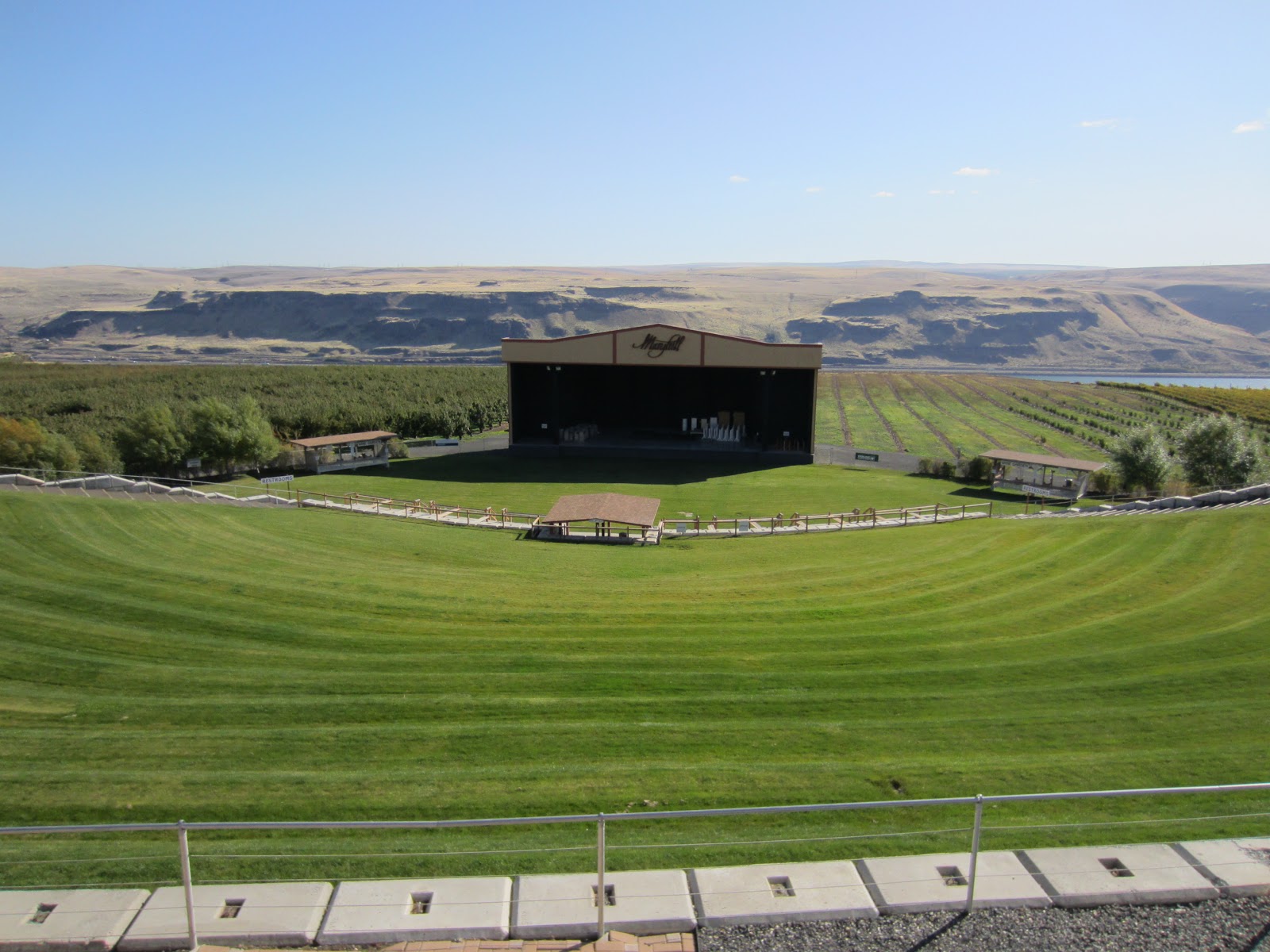
One of the largest wineries in Washington, and the 100th to get their license, was Maryhill Winery. Maryhill can be found on a very scenic ridge that has amazing views both up and down the river. The most exciting thing about this winery is that they truly understand the value of wine tourism. Columbia Valley is at least two hours from the closest major city, and isn't between any major cities either. There are very few wineries in this area, and the ones that are aren't amazing. There are very small communities that are spread out and there aren't a lot of things to do. So they have created a reason for people to come out; concerts. An amphitheatre was built from day one 10 years ago, and they have just opened a brand new multi-purpose stage. They have hosted the likes of Lyle Lovett, Styx and Counting Crows, and most weekends have music playing in the courtyard. The wines are very good but not amazing, and many have some R/S, but that is what their customers want.

The Maryhill amphitheatre and stage
https://picasaweb.google.com/103966152761599927074/ColumbiaGorgeOregonColumbiaValleyWashington?authuser=0&feat=directlink